Home / Where Saw Cuts Go in a Driveway Slab
Where Saw Cuts Go in a Driveway Slab
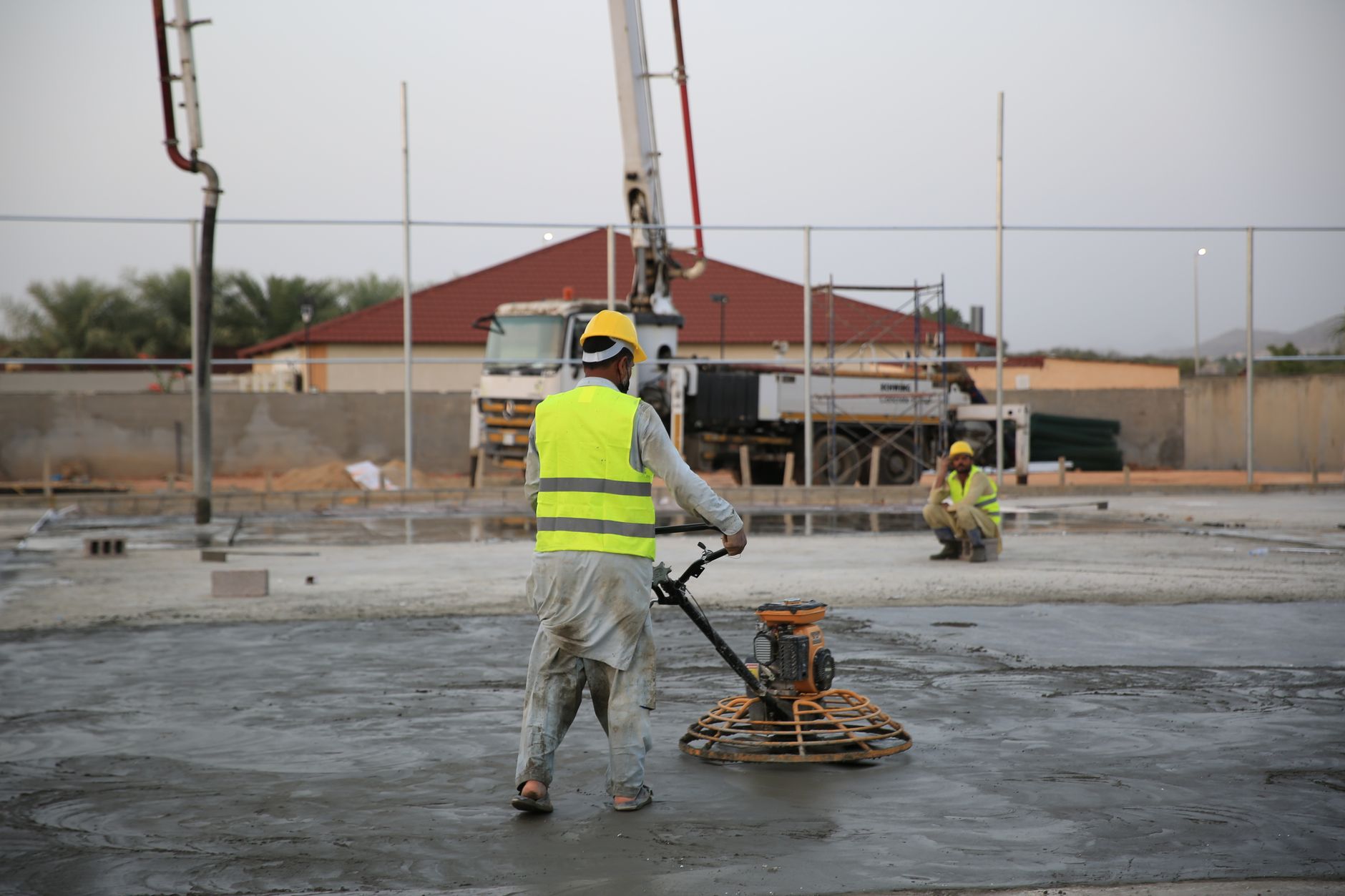
The day after the pour
The finished surface still looks fresh when a second crew, or the same one, comes back with a gas or electric saw and a diamond blade. They walk the slab along chalk lines and cut shallow slots into it. To a homeowner it can feel alarming to see a saw run across a brand-new driveway, but these cuts are what keep the slab from developing wandering cracks. This page covers where the cuts go, when they happen and how deep they need to be.
Why a saw instead of a groove
Joints can be tooled into wet concrete with a grooving tool, but sawing has advantages. A saw produces a straight, narrow, consistent slot. It can cut through a surface that has already been finished, which means the finisher does not have to leave the surface rough for tooled lines. It also allows the layout to be adjusted after the pour, since the chalk lines can be snapped once the whole slab is down and its real shape is visible. The trade-off is timing, because the saw must run within a limited window.
The timing window
Concrete must be hard enough that the blade does not rip aggregate out of the edges, a defect called raveling, yet young enough that stress has not yet built to the cracking point. For many residential slabs that window opens some hours after finishing and closes within about a day, though weather shifts it. Hot, dry and windy days shrink the window, so crews cut earlier. Cool, damp days stretch it, so cuts can wait.
Some crews use lightweight early-entry saws that can cut green concrete within a few hours, with a skid plate that supports the surface and reduces raveling. They are especially useful on hot days. Heavier conventional saws are used when the concrete has set longer. Either way, the crew watches the slab and tests it with a gentle scratch or a trial cut.
If the cuts are made too late, the slab may crack ahead of the blade. A joint that arrives after a random crack protects nothing and leaves two problems instead of one.
Depth of cut
A saw cut must reach deep enough to act as a weak line. A widely used guideline is about a quarter of the slab thickness, meaning that a four inch slab would be cut roughly an inch deep. Some designers prefer a bit more. A cut that is too shallow gets bridged by the aggregate underneath and fails to attract the crack.
Early-entry saws often cut shallower, around an inch or so, and rely on the early timing to do the job. The contractor should know what depth suits their equipment and the slab.
Choosing the layout
The layout of the lines is just as important as the depth. On a driveway, lines usually run across the width at regular spacing, with another line down the middle if the slab is wide. The aim is to create panels that are close to square. A rule of thumb ties maximum spacing to thickness, so a thicker slab tolerates a wider spacing. A common practice is to keep panels no more than ten to twelve feet on a side for ordinary residential thickness, and to tighten the spacing where the slab is thin or the weather hot.
Lines should connect to features that produce stress: the inside corners of the slab, the edges of manholes and drains, and the corners of posts. A joint that begins at a corner and runs across the slab gives the corner relief. Cuts should also end at an edge or at another joint, not stop in the middle of a panel, because a joint that dead-ends invites a crack to continue beyond it.
Marking and cutting
Marking begins with a chalk line or a straight board used as a guide. The operator pushes the saw along the line at a steady pace. Water is often fed to the blade to keep it cool and to control dust, though dry-cut saws with dust collection exist. After the cut, the slurry is washed away, and the crew checks that the cut is clean and straight.
Safety is important. Silica dust from cutting concrete is a health hazard, which is why water or vacuum control is used on professional jobs. Homeowners should keep pets and children away during cutting.
Curves, tapers and odd shapes
Straight saw lines cannot follow a curve, so a curved driveway is cut in straight segments that meet the edge at right angles to the tangent. On a flared apron, where the slab widens toward the street, cuts radiate rather than run parallel, and the panel shapes are adjusted so none ends in a sharp point. A narrow wedge of concrete between two joints tends to chip, so the layout should widen it or drop one line.
Where a driveway narrows to meet a walkway, a cut at the narrowing point gives the neck room to move without cracking the wider part.
Missed or late cuts
Mistakes happen. A crew may cut a line off the planned mark, or leave a section uncut because the window closed. If a random crack has formed in a panel, the usual response is to saw along it, routing the crack into a clean joint, or to leave it and seal it. If whole sections were missed, adding cuts later still helps relieve remaining stress, even though it cannot undo cracks already made. It is worth asking the contractor to explain what was done and why, and to mark the cuts on a photograph for your records.
Cuts and reinforcement
Saw cuts cross reinforcement in a slab only if the reinforcement sits below the cut depth, which it normally does. The blade should not reach the steel. If the reinforcement is placed too high, it will be hit, and a damaged bar or wire is a sign it was not placed correctly. That is another reason the position of the reinforcement matters.
After the cut
The kerf, or slot, is narrow, and many owners leave it open. Others fill it with a flexible joint sealant after the slab has cured, which keeps dirt, weeds and water out. If filling is planned, the contractor should wait until the surface is dry and the slab has had time to shrink, then apply a backer rod and sealant according to the product directions.
Expect hairline cracking to appear in the bottom of the cuts over time. That is the system working. A crack elsewhere in the panel is the thing to watch. If one appears, photograph it and note the date, then check again after a few months to see whether it changes.
What to ask
- Will the joints be sawn, tooled or both?
- Is there a sketch of the cut lines?
- How soon after the pour will cutting happen?
- What depth will be used?
- Who will be responsible if random cracks appear before the cuts?
A contractor who can answer these quickly has done it before. The cuts may seem like an afterthought, but they are the planned failure points that protect the rest of the slab.